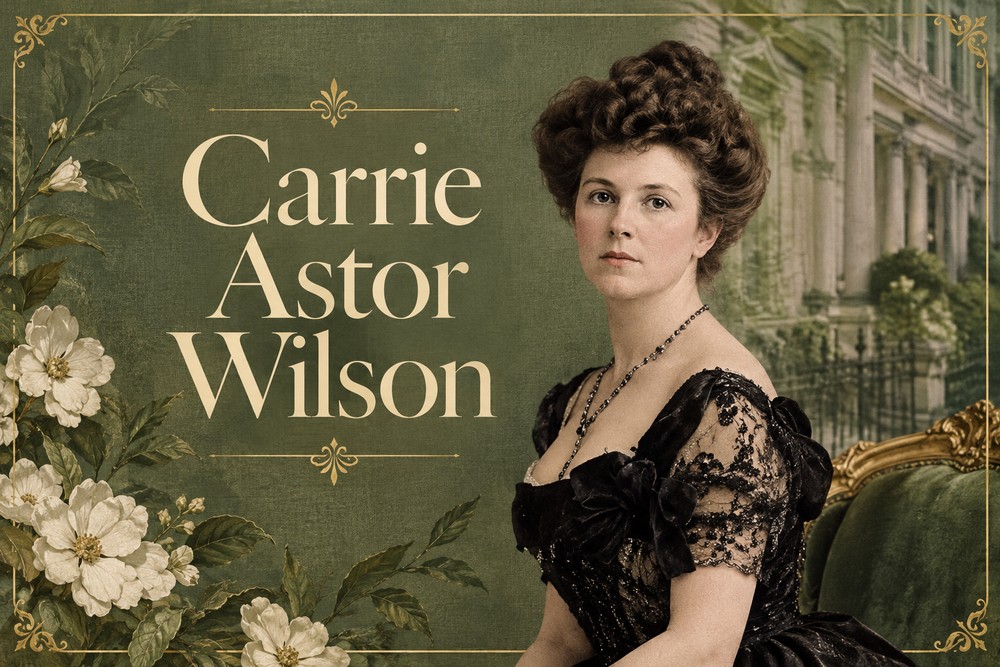
I like to begin with the name because names were weapons in her world. Carrie Astor Wilson was born Caroline Schermerhorn Astor on October 10, 1861, and died on September 13, 1948. She was the fourth of five children of William Backhouse Astor Jr. and Caroline Webster Schermerhorn Astor, the formidable Mrs. Astor who guarded New York society like a dragon at a velvet gate. Carrie was an Astor by birth, a Schermerhorn by her mother, and a Wilson by marriage. Those three names gave her a gold-plated place in Gilded Age New York, but they also boxed her into a role she played with discipline, charm, and a sharp eye for the main chance.
A Name That Opened Doors
When I trace Carrie’s life, I see a woman who inherited an empire of invitations. She was known in public as Mrs. M. Orme Wilson after her marriage, and later writers call her Caroline Schermerhorn Astor Wilson. The family tree around her is crowded enough to fill a ballroom. Her father was a businessman, racehorse owner, and yachtsman. Her mother was the social queen who helped define the Four Hundred. Her only brother was John Jacob Astor IV, who died on the Titanic in 1912. Carrie outlived all four of her siblings and became the last surviving child of William and Caroline Astor. That fact alone gives her a melancholy distinction.
A Childhood in the Astor Brownstone
Carrie grew up at 350 Fifth Avenue, at the southwest corner of Fifth Avenue and 34th Street. The house had a famous ballroom and picture gallery, and Stanford White redesigned its interior in 1879. I picture a childhood of polished floors, calling cards, and dancing lessons. The New York Sun later said her attachment to Marshall Orme Wilson went back to Mrs. Parson’s well-known dancing class, when both were young enough to trust each other before society had priced them. That detail makes Carrie human. Before she was a hostess, she was a girl in a dancing class, practicing steps beside the boy she would eventually marry.
Her siblings formed a glittering, fragile row. Emily Astor, born in 1854, married James John Van Alen and died in 1881. Helen Schermerhorn Astor, born in 1855, married James Roosevelt Roosevelt, half-brother of Franklin Delano Roosevelt, and died in 1893. Charlotte Augusta Astor, born in 1858, married James Coleman Drayton, divorced, and later married George Ogilvy Haig in London. John Jacob Astor IV, born in 1864, married Ava Lowle Willing and then Madeleine Talmage Force. He went down with the Titanic on April 15, 1912. Carrie, born in 1861, watched the family candles go out one by one.
The Vanderbilt Ball and the Wilson Wedding
The episode that fixed Carrie in Gilded Age lore came in 1883, when Alva Vanderbilt gave a masquerade ball for about 1,000 guests. Carrie had rehearsed a quadrille and expected to dance. She was left off the list because her mother had never formally called on Alva. Carrie pressed her mother. Mrs. Astor sent her card. The Astors were invited, and the social wall cracked. I find this story irresistible because it shows Carrie as a young woman who wanted her place in the room and was willing to push her mother toward the door.
In 1884 she married Marshall Orme Wilson, a banker from a newly rich Tennessee family. The engagement was announced in Paris. They married on the afternoon of November 18, 1884, in the art gallery of the Astor house. The wedding was the social event of the season. A necklace costing $75,000 led the newspaper account, and the bride wore beautiful examples of Worth’s art. The ceremony itself had about 250 guests, while the wider festivities were far larger. I keep the numbers close because they show the scale of the performance. This was not a private vow. It was a public merger of names.
The House on East 64th Street
Carrie’s own showpiece was 3 East 64th Street, a Beaux-Arts limestone mansion by Warren & Wetmore. It was built from 1900 to 1903 on a plot about 65 feet wide, with roughly forty rooms, a circular atrium, and a blue-slate mansard. The deed was put in Carrie’s name. On January 21, 1904, she opened the house with a party for about 300 people, and Lillian Nordica and Enrico Caruso performed. I imagine the atrium as a jewel box, with the city pressing its face against the glass.
Her entertainments were not only for pleasure. In January 1913 she staged tableaux vivants for a district nurse in the babies’ ward of Post-Graduate Hospital. On February 2, 1916, she hosted a concert and one-act comedy for students of the École des Beaux-Arts serving at the front and for their families. In January 1919 she invited guests to hear Captain Guilliland speak about fourteen months in German prison camps. She also hosted a sewing class connected with the Cathedral of St. John the Divine and the Fresh Air Association. She was a member of the Colony Club and vice president of the New York Women’s League for Animals. Her charity work was not a footnote. It was the practical shell around the social pearl.
Husband and Sons
Marshall Orme Wilson was born in Nashville on June 20, 1860, and died at 3 East 64th Street on April 1, 1926. He was a banker, a Columbia graduate, and a man whose family had money and ambition but not the Astor pedigree. The Astors resisted the match at first. The Wilsons were Southern and new. Yet the marriage lasted more than forty years. His will gave each son $500,000 and an equal life interest in the residuary estate. Carrie received all personal and household effects in lieu of dower. She did not remarry. She lived another twenty-two years.
Their two sons carried the Wilson name into public life. Marshall Orme Wilson Jr. was born on November 13, 1885. He graduated from Harvard in 1907, served in the U.S. Army in the First World War, and became a career Foreign Service officer. President Franklin D. Roosevelt appointed him ambassador to Haiti on March 21, 1944. He presented credentials on June 2, 1944, and left the post on August 22, 1946. Richard Thornton Wilson III was born on December 15, 1886. He graduated from Harvard in 1908 and from New York Law School in 1910, but his real work was collecting. From 1936 he gave the Metropolitan Museum of Art more than 500 pieces of European pottery and porcelain. He told the museum he wanted his hobby to please his fellow townspeople. A mother can leave many legacies. These two sons were among Carrie’s most visible ones.
Parents and Siblings
Carrie’s mother, Caroline Webster Schermerhorn Astor, was born on September 22, 1830, and died on October 30, 1908. She was the daughter of Abraham Schermerhorn and Helen Van Courtlandt White. With Ward McAllister she defined the Patriarchs and the Four Hundred. She defended old money against new fortunes, and she insisted on being Mrs. Astor without a qualifying initial after her brother-in-law died in 1890. That quarrel helped push the family uptown. Carrie was with her mother at the end. On the afternoon of October 30, 1908, Carrie went from her own house to the Astor mansion. Only Mrs. M. Orme Wilson was with Mrs. Astor when she died that evening.
Carrie’s father, William Backhouse Astor Jr., was born on July 12, 1829, and died on April 25, 1892, in Paris. He was a businessman, a racehorse owner whose horse Vagrant won the 1876 Kentucky Derby, and a yachtsman. He preferred the yacht Ambassadress and the Hudson River estate Ferncliff at Rhinebeck to his wife’s ballroom. He gave Carrie and Orme 414 Fifth Avenue as a wedding present and, the day after the wedding, a further registered certificate of $100,000. He supported abolition before the Civil War and paid to equip a Union regiment. I like that contrast. The man who loved yachts and horses also put money behind a cause.
The Wider Schermerhorn and Astor Kin
The family tree has deep roots. Carrie’s paternal grandfather was William Backhouse Astor Sr., born September 19, 1792, and died November 24, 1875. He was the son of John Jacob Astor and Sarah Cox Todd. Carrie was John Jacob Astor’s great-granddaughter, not his granddaughter. That generational distinction matters. John Jacob Astor died in 1848, thirteen years before Carrie was born. Her paternal grandmother was Margaret Rebecca Armstrong, daughter of John Armstrong Jr. and Alida Livingston. That line gave Carrie a Livingston descent and a place in the old Dutch and Hudson River networks.
On her mother’s side, Carrie’s maternal grandfather was Abraham Schermerhorn, born April 9, 1783, and died February 3, 1850. He was a merchant and ship chandler. Her maternal grandmother was Helen White Schermerhorn, born Helen Van Courtlandt White on November 12, 1792, and died May 25, 1881. Helen was the daughter of Henry White and Anne Van Cortlandt White. Carrie was nineteen when this grandmother died. The maternal uncles named in family records were Henry White Schermerhorn, who died in infancy in 1811, Augustus Van Courtlandt Schermerhorn, who lived from 1812 to 1846, and Archibald Bruce Schermerhorn, who lived from 1814 to 1862. None of them lived into Carrie’s adult life. They belong in the family tree, but not in her ballroom.
A Ledger of Family Landmarks
| Date | Person or Event | Detail |
|---|---|---|
| October 10, 1861 | Carrie Astor Wilson born | Fourth of five children |
| 1883 | Alva Vanderbilt’s masquerade ball | Carrie left off the list, then included |
| November 18, 1884 | Carrie marries Marshall Orme Wilson | Wedding in the Astor house art gallery |
| November 13, 1885 | Marshall Orme Wilson Jr. born | Future ambassador to Haiti |
| December 15, 1886 | Richard Thornton Wilson III born | Future museum benefactor |
| 1900 to 1903 | 3 East 64th Street built | Warren & Wetmore mansion |
| October 30, 1908 | Mrs. Astor dies | Carrie at her bedside |
| April 1, 1926 | Marshall Orme Wilson dies | At 3 East 64th Street |
| September 13, 1948 | Carrie dies | At her son Richard’s home |
Charity, Widowhood, and the Astor Cross
In 1914 Carrie commissioned the Astor Cross in Trinity Church’s north churchyard. The cenotaph was designed by Thomas Nash and illustrates the genealogy of Christ in Luke’s Gospel. Mrs. Astor herself is buried in the Astor mausoleum at Trinity Cemetery uptown, not under the cross. I find this detail moving. Carrie built a memorial that points beyond her mother’s social throne toward something older and quieter. The cross was conserved in 2024 by EverGreene Architectural Arts for Trinity Church.
Carrie’s widowhood was long and public. She kept the 64th Street house until it was sold after her death. On December 12, 1948, the Government of India bought 3 East 64th Street as headquarters for its diplomatic representatives in New York. The house later became New India House. Carrie died on September 13, 1948, at the home of her son Richard, identified as 1 Sutton Place. Her funeral was held at Trinity Church, and she was buried with her husband in the Wilson Mausoleum at Woodlawn Cemetery in the Bronx. Her life began in a brownstone at 34th Street and ended in a Sutton Place apartment. Between those addresses she danced, married, built, gave, and mourned.
FAQ
When was Carrie Astor Wilson born and when did she die?
Carrie Astor Wilson was born on October 10, 1861, in New York City. She died on September 13, 1948, at the age of 86.
Who were her parents?
Her parents were William Backhouse Astor Jr. and Caroline Webster Schermerhorn Astor, the social leader known as the Mrs. Astor. Her father was a businessman and yachtsman. Her mother was the gatekeeper of Gilded Age society.
Who did she marry and when?
She married Marshall Orme Wilson, a banker, on November 18, 1884. The wedding took place in the art gallery of the Astor house on Fifth Avenue. They had two sons.
Did she have children?
Yes. She had two sons. Marshall Orme Wilson Jr. was born in 1885 and became a career diplomat and ambassador to Haiti. Richard Thornton Wilson III was born in 1886 and became a noted collector and benefactor of the Metropolitan Museum of Art.
What was her connection to the Vanderbilt ball?
In 1883 Carrie was left off the guest list for Alva Vanderbilt’s masquerade ball because her mother had not called on Alva. Carrie pressed her mother, Mrs. Astor sent her card, and the Astors were invited. The episode became one of the most famous social maneuvers of the Gilded Age.
Where did she live?
She grew up at 350 Fifth Avenue. After her marriage she lived at 414 Fifth Avenue, a wedding present from her father. Her own showpiece was 3 East 64th Street, a mansion built from 1900 to 1903. She died at her son Richard’s home at 1 Sutton Place.
Is she the same as Caroline Schermerhorn Astor?
No. Carrie was Caroline Schermerhorn Astor Wilson, often called Carrie. Her mother was Caroline Webster Schermerhorn Astor, the Mrs. Astor. The two women shared a name and a social world, but they were mother and daughter.
What happened to her East 64th Street house?
After Carrie’s death the house was sold. In December 1948 the Government of India bought 3 East 64th Street for its diplomatic representatives in New York. The building later became known as New India House.
Why does she appear in The Gilded Age?
She appears as a recurring character in HBO’s The Gilded Age, played by Amy Forsyth. The series uses her as a young woman caught between family expectations and her own desires, especially around the Vanderbilt ball and her marriage to Marshall Orme Wilson.